A Beginner's Guide to Fishing Rod Lengths
 Pete McPherson Published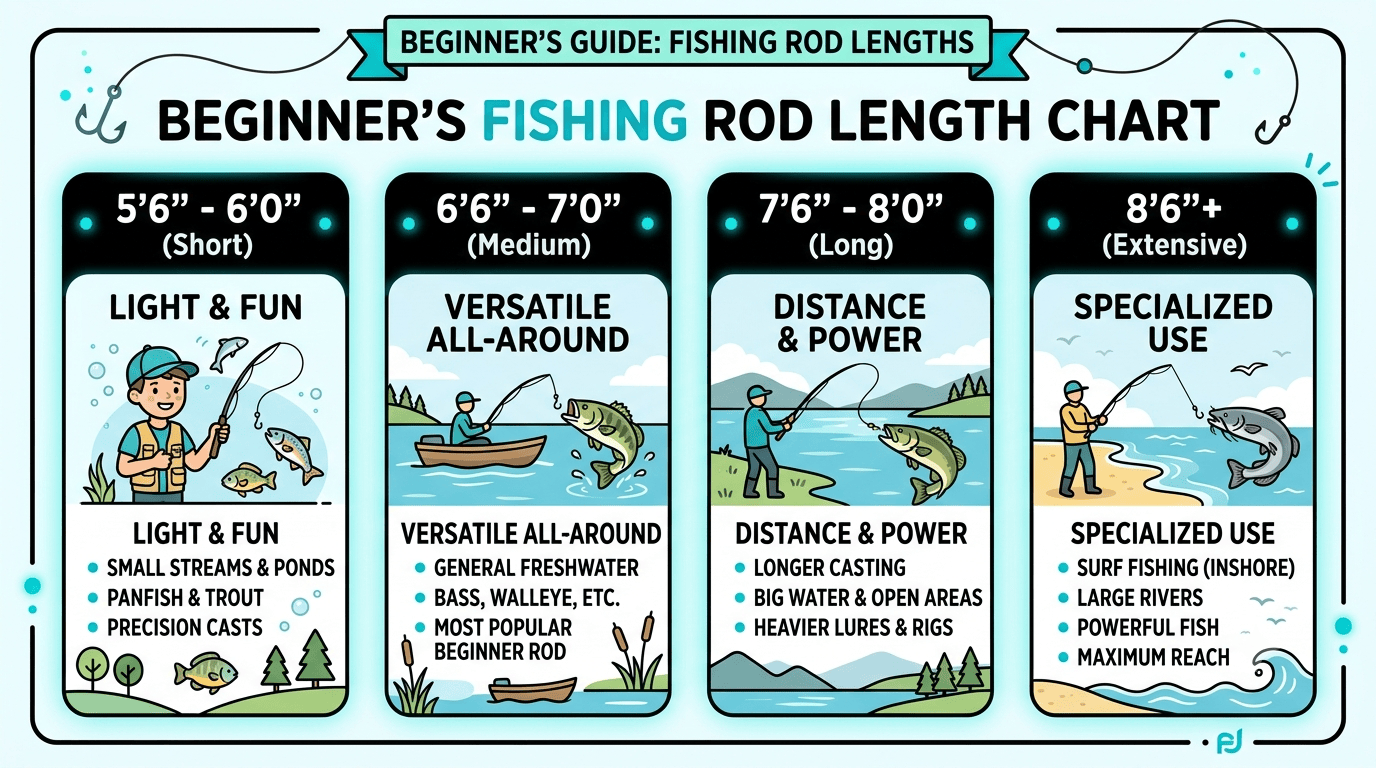
Rod length is one of the first choices you make when buying a rod, and it changes how your whole day on the water feels. This guide breaks it down in plain English so you can pick with confidence.
First, what does “rod length” even mean?
Rod length is measured from the very tip of the rod to the bottom of the handle. It’s usually written in feet and inches, like 6’6” (six feet, six inches) or 7’0” (seven feet).
You’ll find most rods somewhere between 5 and 9 feet. That’s the whole range you really need to think about as a beginner.
That number is printed right on the rod, usually just above the handle, next to the “power” and “action” ratings. Don’t worry about those two for now. Length is enough to get started.
The one rule to remember
Here’s the trade-off that explains almost everything about rod length:
- Longer rods cast farther. More reach, more distance.
- Shorter rods cast more accurately. More control, easier to aim.
That’s it. Everything else is just details on top of that rule.
Why does a longer rod cast farther? Think of the rod tip as the end of a whip. When you cast, the tip travels in an arc. A longer rod means a bigger arc, so the tip moves faster. That extra speed flings your lure farther. One study cited by tackle retailers found that rods over 7 feet added roughly 10–20% to casting distance compared to shorter rods (FishUSA).
Shorter rods give up some of that distance. In exchange, they’re easier to steer. When you’re standing under trees or trying to drop a lure next to a dock, control beats distance every time.
The short answer for most beginners
If you want one number and nothing else: get a 7-foot rod.
A 7-footer sits right in the middle. Decent casting distance, decent accuracy, and it handles most situations you’ll run into. Nearly every “best beginner rod” list lands on somewhere between 6 and 7 feet for this reason (Dick’s Sporting Goods).
Buy the 7-foot rod, learn on it, and figure out your favorites later. You really can’t go wrong.
Now, if you already know where you’ll be fishing, you can do a little better than “just get a 7-footer.” Here’s how length maps to real situations.
Rod length by where you fish
Small streams and tight, brushy spots (5 to 6 feet)
Fishing a narrow creek with trees hanging overhead? A short rod is your friend.
A 5 to 6-foot rod is easy to swing in tight quarters. You won’t catch the tip on branches every other cast. And because short rods aim better, you can slip a lure into small pockets of water without spooking the fish.
General, all-around fishing (6.5 to 7.5 feet)
This is the sweet spot for lakes, ponds, and rivers from a bank or a boat. It’s the “does everything okay” zone.
If you’re bass fishing, throwing small lures, or just learning, live here. A 6’6” to 7’6” rod covers the widest range of what a beginner does.
Fishing from a kayak or small boat (6.5 to 7 feet)
In a kayak you’re sitting low and close to the water, and space is tight. A rod that’s too long is awkward to cast and hard to land a fish with.
Stick to around 6.5 to 7 feet. Long enough to cast well, short enough to manage without smacking the rod on your paddle.
Fishing from a pier, jetty, or high bank (7 to 8 feet)
When you’re up high or need to reach past rocks and pilings, a bit more length helps. A longer rod gives you leverage to steer fish around obstacles and keep your line up off the structure.
Seven to eight feet is a comfortable range here.
Surf fishing on the beach (9 to 12+ feet)
This is the big one. To reach the fish, you have to launch a bait way out past the breaking waves.
Surf rods are long on purpose, often 9 to 12 feet or more. Anglers using 9-foot surf rods have reported casts 30–40% longer than folks using standard 6 to 7-foot rods (Battlbox). If beach fishing is your goal, this is one time you’ll skip the 7-footer entirely.
A quick word on “leverage.” When a fish pulls, a longer rod bends into a bigger curve, which acts like a shock absorber and helps you steer the fish. A shorter rod gives you more direct, brute pulling power for hauling a fish out of heavy cover. Neither is “better,” they just do different jobs.
Length isn’t only about the fish. It’s about you, too.
A general guideline: a rod shouldn’t be much taller than you are. If a 7-foot rod feels like wrestling a flagpole, that’s a sign to size down. A rod you can cast comfortably all day beats a “better” rod that wears out your arm by lunch.
Give it a test swing in the store if you can. Hold it, mime a cast, and see how it feels. Comfort now saves sore shoulders later.
A note on travel and storage
Rod length affects one boring-but-real thing: getting the rod home and stowing it.
A one-piece 7-foot rod is a single stiff stick. Great to fish with, awkward to fit in a small car. If storage or travel is a worry, look for a two-piece rod. It breaks into two halves that fit in a trunk or a closet, and it casts almost identically to a one-piece.
There are also telescopic rods that collapse down to a foot or two. They’re handy for backpacking, though they usually don’t cast quite as smoothly. For a first “everyday” rod, a two-piece is the easy middle ground.
Rod length for kids
Kids need shorter, lighter rods they can actually control. A rod that’s too long is heavy, tiring, and frustrating, which is the fastest way to make a kid hate fishing.
A rough guide by age (Crestliner):
- Ages 3–5: a 2 to 3-foot rod
- Ages 6–8: a 4 to 6-foot rod
- Ages 9–12: a 5 to 7-foot rod
- Ages 13+: a standard 6 to 7.5-foot rod
The simple rule: the shorter the kid, the shorter the rod. Shorter rods are lighter and easier to cast, so kids catch on faster and have more fun.
A quick cheat sheet
| Where you fish | Rod length |
|---|---|
| Small streams, tight cover | 5–6 ft |
| All-around / just starting | 6.5–7.5 ft |
| Kayak or small boat | 6.5–7 ft |
| Pier, jetty, high bank | 7–8 ft |
| Surf / beach | 9–12+ ft |
The bottom line
Don’t overthink your first rod. Length is a trade-off between distance and control, and a 7-foot rod balances both better than anything else.
Get one, spend a season learning on it, and pay attention to where you fish most. When you’re ready for rod number two, you’ll know exactly whether you want to go shorter for control or longer for distance.
FAQs
What’s the best all-around fishing rod length for a beginner? Seven feet. It balances casting distance and accuracy and handles most freshwater situations, so it’s the safest first buy.
Does a longer rod really cast farther? Yes. A longer rod has a bigger casting arc and a faster tip, which throws lures farther. The trade-off is that longer rods are harder to aim precisely.
Is a shorter rod better for accuracy? Yes. Shorter rods flex less and are easier to control, so you can place a cast more precisely, which matters around docks, trees, and tight cover.
What rod length should I get for my kid? Match it to their size. Roughly 2–3 feet for ages 3–5, 4–6 feet for 6–8, and 5–7 feet for 9–12. Shorter and lighter is always easier for a child to handle.
Do I need a long surf rod if I’m only fishing lakes and ponds? No. Long surf rods (9–12+ feet) exist to reach past ocean waves. For lakes, ponds, and rivers, a 6.5 to 7.5-foot rod is plenty.